
Maria the lovely Turtle Project Coordinator has been away this week, so in her absence I have been leading the turtle team. They support CONANP with their regular patrols so I have been able to join in! On Monday and Wednesday we joined the team, who are mainly community volunteers, and worked with them to measure and tag the turtles who were nesting. We also helped with clearing out nests where the clutch has hatched, but there are still hatchlings that haven’t made it out yet.
This is what a night walk looks like…….

It´s 22.10 so I pull on leggings, socks and a long sleeve top and gather my red light torch, water and camera. I jump in the truck and go to pick up the participants. Security guards open the gate to let me out of our complex, they recognise the truck so always wave and smile as we leave. The roads are quiet, although street cafes (mainly ramshackle huts) have full tables, serving tacos and beer with music that energises the warm night. It´s 28 degrees and humid; long sleeves feel stifling but are necessary protection against mosquitos desperate for a protein fix before they lay eggs. Team Turtle jump in to the truck, summer chillout tracks are playing and we head for the rollercoaster road to the beach. A couple of hotels have set up security to deny people access to the public beach, but we pass through now with the magic words “ayudamos a las tortugas” They used to ask all of our names, but got fed up with writing mine down so now just wave us through as long as we slow enough for them to look in the windows.
We quickly get past the hotels and their powerful lights and head into the dark, driving parallel to the mangrove forest. We all keep our eyes peeled for the reflection of eyes that could be a crocodile, but as yet they have stayed away. We do see bats, big spiders, and racoons who dart in front of the truck then away again, much like the pheasants at home on some kind of death wish. Suspension and spines jarring we move slowly along the road until we get to a clearing where CONANP park their vehicle. The hut that we are allowed to use as a base is a short walk from our vehicles and we go and get set up. We put on rubber gloves to protect against the salmonella, gather up posts to mark nests, a GPS tracker, bucket , tape measure, iodine solution and a little hand held tagging device. We split into two teams and head off in opposite directions along the beach. The sky is clear, stars and moon giving a little help outlining silhouettes against the overwhelming blanket of darkness. The red torches are more to confirm the sight of a turtle than to help traverse the undulating surface of the sand and inevitable holes and track marks from the slow moving creatures we are seeking. Our guides speak little English so we communicate as much in Spanish as we can, difficult in this darkness without the assistance of gestures and facial expressions.
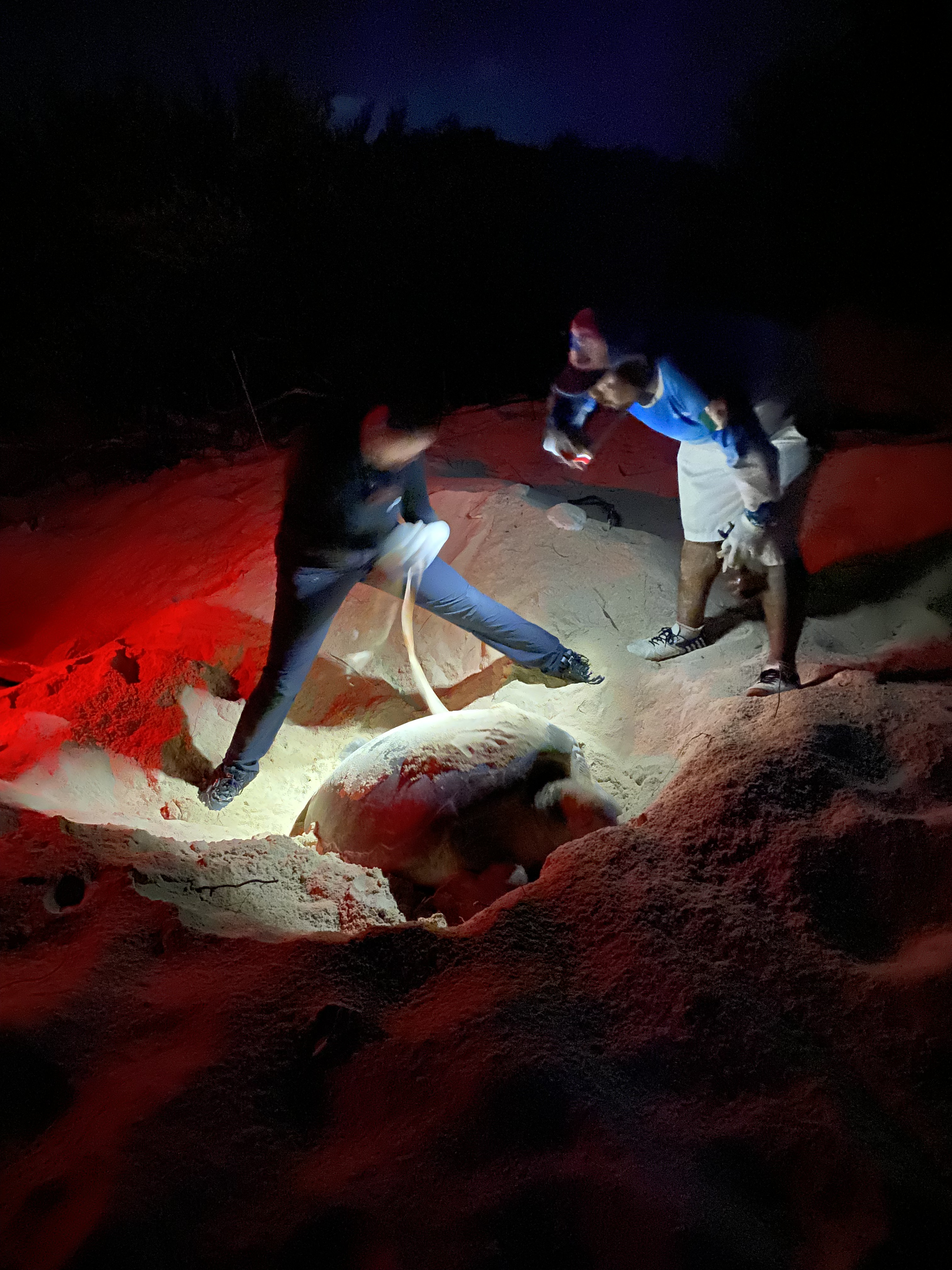
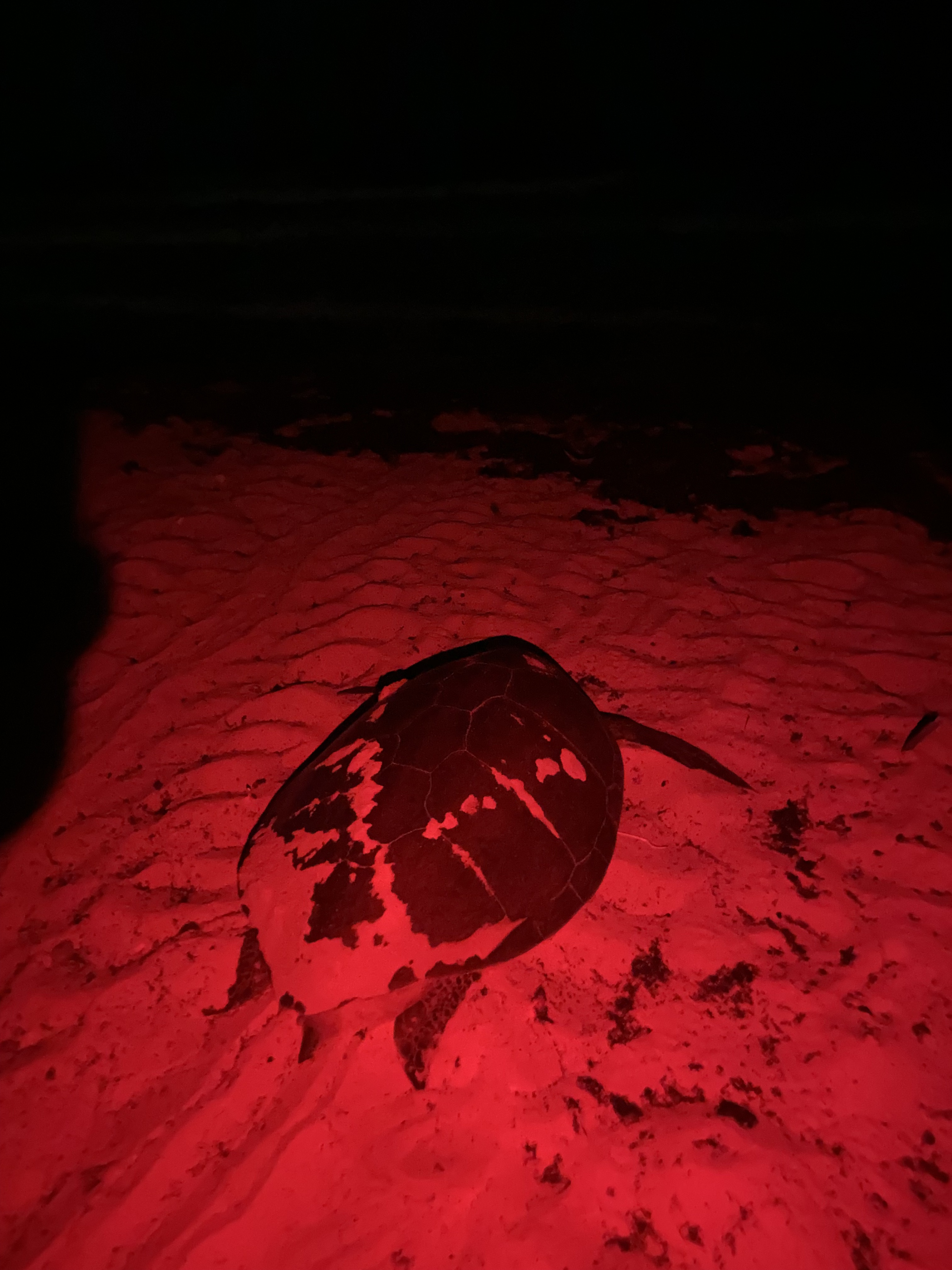
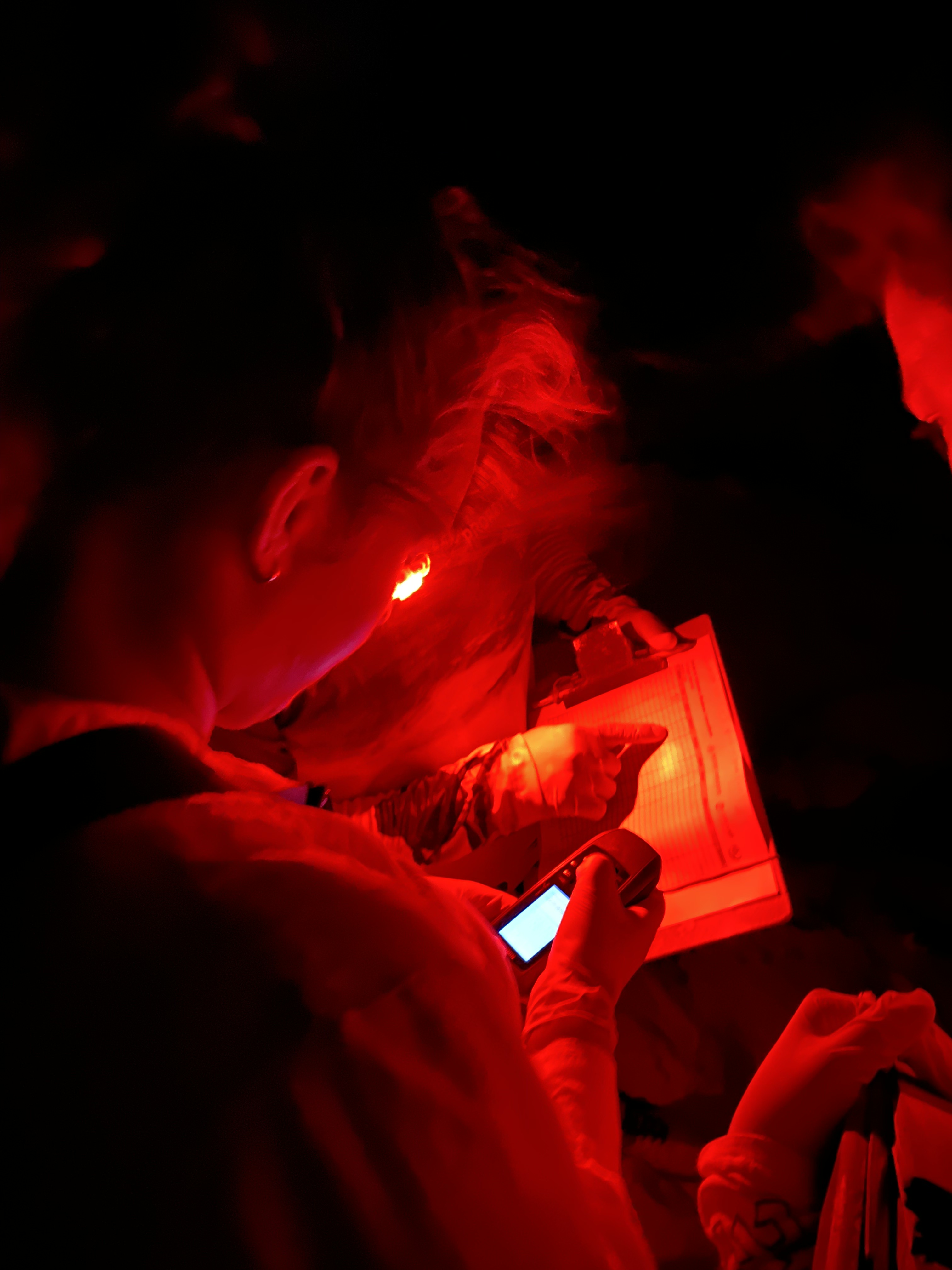


When a turtle is ready to lay her eggs, she hauls her considerable bulk across the sand until she is finds a spot that she is satisfied gives her babies the best chance of survival (estimated at only 1/1000), the turtle moves around using all four flippers to create a hole in which to deposit her beautiful white eggs. Green turtles lay up to 200 eggs in one clutch, after which they slowly cover the eggs with sand but using their front flippers like scoops. The process is exhausting for them, and it is at this point we can tag a front flipper. The flipper is sprayed with iodine solution to reduce any risk of infection then one a little machine is used to tag them with a metal tag stamped with a number that is then recorded. Someone else measures the carapace from front to back and side to side, and identifying features such as a carapace damaged by a shark bite are noted. The GPS coordinates from the new nest are also written down and a post is dated and placed in the sand to mark the new nest. The whole process takes a few minutes, only red light is used to distress the turtle as little as possible, and the turtle normally just stays fairly still and lets us move around them without any obvious discomfort. Sometimes we will see the outline of the dome of the carapace as a turtle makes her way back out to sea then we mark the nest in the same way but without tagging the turtle. Green turtles become sexually mature at around 25 but may not start nesting for several years after that. Every 2-5 years they will undertake their reproductive migration and will then nest every two to three weeks for several months before they leave again.
When we see nests that have hatched someone starts to dig with their hands deep into the nest so that any dead hatchlings and non viable eggs can be recorded, and any live hatchlings are rescued and assisted on their journey to the sea. We frequently saw scattered eggs where a nesting turtle had disturbed a nest that was already there. If this is the case there is a window of about 5 hours to get the eggs back in the ground before they die. The volunteer digs until they reach compacted sand, often handing up tens of little hatchlings which go into a bucket until we are sure that the nest is empty. The little turtles squirm around in the box, standing on each other in their automatic response to the call of the sea. It is truly lovely to see their perfectly formed tiny carapace and flippers, so small in comparison to the bulky female that has laid so many eggs and worn herself out dragging herself up the beach and digging a nest to protect these babies against the elements and all of the other predators.


There were a few babies who had a carapace that had been deformed, normally curving more one way which made one front flipper useless as it got pinned to the sand so the propulsion across the sand was affected. The deformities we saw in the adult females were all caused by predators: propellor damage, missing flippers from shark attacks and shark bites out of their carapace. We finish up when there are no more turtles laying, or nests that have hatched and we haven’t cleared, and go back to the hut to clean our hands, record data and pick up kit. The drive home is slow and there are less people around. Restaurants have shut their doors for the night and houses are in darkness. I drop off the participants then make my way home to send a couple of photos to people in England who are up and about, as although its 3.30am here work has started at home. Exhausted I climb into bed and hope I will get a few hours sleep before I start work again the next day. I want to dream of the turtles I have gazed at tonight, memorizing their faces and slow movements. From nest to death these gentle creatures, so graceful in the water and vulnerably weighty on land, are dodging so many predators and damage from humans, be it poaching or unintentional damage from us encroaching into their world. These nights have left me physically and emotionally drained and yet buzzing from this snapshot into a world that feels so far away from my normal life. I have learned lots about the turtles and their habitat, have questions I didn’t know to ask before, and so much respect both for the majestic creatures I have been so privileged to see up close, and for the volunteers who do this several nights a week for months every nesting season.

David Attenborough put it perfectly when he said
“It seems to me that the natural world is the greatest source of excitement; the greatest source of visual beauty; the greatest source of intellectual interest. It is the greatest source of so much in life that makes life worth living.”

 Abi's Deep Dive
Leave a comment